Thursday, June 9, 2011

PORTSMOUTH, VIRGINIA

Welcome to the Portsmouth/Norfolk area.

Well, we are currently anchored in front of the town of Hampton, Virginia.  Originally, we had planned to go to Jamestown Island, way up the James River to visit the earliest English settlement.  Well, it was nearly 100 degrees and getting hotter as we cruised up the river so we consulted the cruising guides and found that we can rent a car in Hampton and get to Jamestown, Yorktown, and Williamsburg just as easily from Hampton.  So, here we are.  Another thing is that our Ideal Windlass motor quit on us.  So, this means pulling the anchor by hand until I can get the company to repair it for me.  I have sent them an email and hope to hear from them today.  We are going to keep moving however and try to anchor in as shallow water as possible to keep the amount of chain I have to pull manually to a minimum without sacrificing safety.  Pain in the ass, but that's cruising.

We had a nice time in Portsmouth.  We stayed in a marina for a couple nights since we had to fill up on fuel, water, and empty the holding tank, and wanted to have a base place for a couple nights while we figured out what to do next. 


So, as usual, we took off walking and tried to figure out what the place was all about.  Portsmouth was founded after Jamestown, but not that long after Jamestown by a guy named Crawford who was looking for a place to build a ship yard.  Well, he found his ideal spot, asked the King's permission, got the land, and started his ship yard.  By the way, it is still in use today only now it is called the US Navy Shipyard Portsmouth.  It's a little bigger than it was originally, and there is a lot more capability, from the looks of all the cranes, and warehouses, etc. 


Basically, that's how Portsmouth got started and, to this day, the town is all about ship building.  As you may know, Portsmouth is neighbors with Norfolk and Newport News, also big ship building towns.  Portsmouth, however, has a nice colonial heritage, and is also the home to the Coast Guard's 5th Fleet.

We walked around the town and visited the colonial historic district and enjoyed some very cool homes.  We checked out a lightship called Portsmouth.  We checked out the local Naval History Museum.  I think the most fun we had, however, was going out to dinner and a movie.


We found this movie theatre and thought no more of it than that.  They were showing the most recent episode of Pirates of the Carribean at 7:00 pm so we decided we would go.  When we got there, however, things got quite interesting.  We went up to the ticket window, and the person inside waived us in the theatre and asked us if we wanted to see the movie.  Of course we said we did and he said we were in luck; that he had two tables left.  Tables?

So, we were issued our tickets and were then led inside by a person who directed us to a table and chairs in the center of the theatre.  The inside of the theatre was completely redone.  Instead of rows and rows of seats as you would anticipate in a movie theatre, it was set up like a multi level dining room.  There was a phone on the table from which we placed our dinner orders.  You had to use the phone for everything.  Even if you simply wanted a refill of your iced tea.  Within minutes, your request was delivered.  It was a great way to watch a film.  All service and dining was complete by 7:00 when the movie began.

The owner of this theatre bought the place back in 1985 and completely renovated the place to do what he and his family are still doing today.  What a great idea.


As I said, we are in Hampton, Virginia for the next day or so.  We have a rental car reserved and will follow up on what to do about the windlass today.  I'll let you know more later.  That's all for now.

That's one old bottle of rum.

Wednesday, June 8, 2011

ELIZABETH CITY AND THE GREAT DISMAL SWAMP CANAL

We were not really sure why we were going to Elizabeth City other than it sits at the gateway to the Great Dismal Swamp Canal route we chose to take to the Chesapeke Bay.  However, when we got there, we found a great little city.


This is the Navy blimp hangar on the Elizabeth River just south of Elizabeth City.
As we were on our approach to Elizabeth City, we noticed that there were high speed racing boats buzzing around what appeared to be a set course in the river right before the area we had to cross to get to the town docks. 


Then, from off to the side, we were charged by a fast moving Wildlife patrol boat, aka the "po po".  So, we stopped and he came along side.  I said, "Howdy" and he said, "The river's closed."  I said, "Oh, really!? And for how long?"  He told us we might have to wait an hour or so and asked where we were going.  So, we told him, and he said we could anchor and wait.  There were a number of small boats anchored, and he told us not to go past the line they were making.    So, that's fine, we anchored out and enjoyed some high speed boat racing. 


It's only later that we really learned to enjoy this sport.  In the interim, however, it was fun to put the beach chairs out on the bow and catch a glimpse of some of these boats running the track at speeds approaching 100 mph.

Soon enough, we figured out what vhf radio channel the folks in charge of this thing were on so we listened in on the logistical end of things.  We heard them talking about us and the Wildlife guy was asking if there was a way they could get us through as we had been waiting for over an hour and a half.  Eventually, they told him to get us and another couple waiting boats through.  They were asking about our wake and were told it was really small.  I sometimes wonder if they were more worried about our wake messing up the race course or the fact that we were moving so slowly so as not to make a wake and might have been holding them up.  Oh well, you can't win for trying.

Well, we got through and found a piece of bulkhead to tie up to.  No electric or water, but no charge for the dockage either.  Elizabeth City has a reputation for its hospitality to boaters.  This derives from their fervent belief that the Dismal Swamp Canal should remain open and an important part of North Carolina boating.  There was an old guy who lived nearly 90 years in Elizabeth City who, for many of those years, showed up at the docks to greet visiting boaters with a bottle of wine and a rose from his garden.  He became rather popular and several others joined his cause.  They became known as the Rose Buddies, and E City's reputation for parties on the dock anytime there were five or more visiting boats was secure. 


When we got there, it was nice to see several other boaters show up along the wall offering to help with our lines.  There was no difficult involved whatsoever, however, it is nice to see cruisers helping cruisers.  Once we were tied up, a fellow cruiser gave us the rundown.  We then settled in.  Later that evening, there was a makeshift party on the dock.  A bunch of the other cruisers busted out with their musical instruments (I with my backpack guitar) and a little concert on the dock was had.  That was fun.


 Later, we went to this deck bar where there was a country music band playing.  This was honestly the first time I have ever listened to country music (which I really like) in a place were folks listen to country music.  It's just not the same in California.  Country music just sounds better riverside in Elizabeth City, North Carolina.  What can I say?  It's simply better.

The next day, we took off early and went exploring.  There is a very nice downtown waterfront area.  Unfortunately, when we visited, many of the streets were all torn up as part of this large scale refurbishment.  As such, nothing was open (it was Sunday), and many businesses were closed permanently.  We did some sight seeing, however, and enjoyed a number of very nice old structures built back in the colonial times.  Yes, another 4C town.  Nice, nonetheless.


However, we did find the racing event and really had a good time with that all afternoon.  We talked to a couple crew dudes on the side of the river who explained how these races are run.  There were sponsored pro's as well as amatures, and even kids running these boats.  Everybody sure looked like they were having fun.


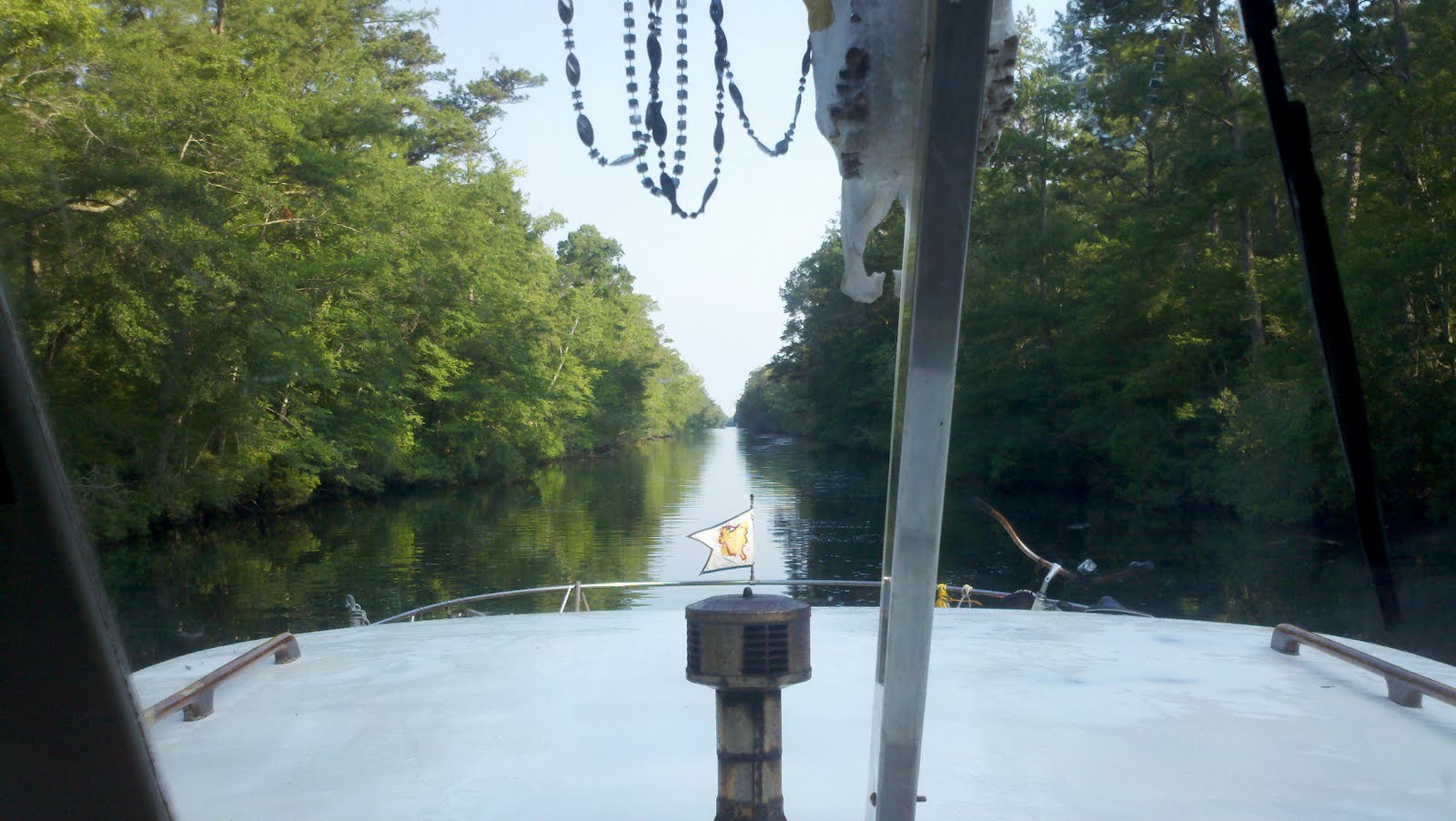
The next morning, we left at sun up so we could make the run all the way to Portsmouth, Virginia by way of the Great Dismal Swamp Canal.  There are two routes you can take from the bottom of the Albemarle Sound to get to the Chesapeke.  You can take the Virginia Cut which is deeper and somewhat faster, with only one lock and one bridge, or, you can take the slower and much more scenic Dismal Swamp Route with its two locks and several bridges.  We chose the latter.


George Washington was interested in the Dismal Swamp as a supply of timber in the late 1700's.  So, he bought up 45,000 + acres and started a project to dredge the canal so he could get the lumber out.  The issue was not so much building the canal, but maintaining it. 


He and others over the years grew tired of this until the mid 1900's when it was taken over by the Army Corps of Engineers who maintain it today.  They don't do much dredging, but from what I understand, they do keep the trees from completely enclosing the ditch.  Almost the entire route is a "no wake zone" as it is important to the powers that be that there be as little bank erosion as possible.  I can understand this.  This is why mostly trawlers and shallow draft sailboats take this route.  It is a lazy stroll through a primordeal forrest. 


The water was so still that it was hard to tell where the water ended and where the banks began. So, what you do is drive in "the window" - the reflection of the sky in the water.  It doesn't change regardless of the position of the sun.  This is all you can do.  It's so narrow, your radar will not help you stay in the middle.  You have to do it all by sight alone.  The water was not very deep.  We saw an average of 7-8 feet most of the way (about 40 miles), but did bump whatever litters the bottom a couple times.  Nothing really hard and no damage.  Just bumps.  Probably the bottom of the keel bouncing over a sunken log.  I would not recommend running this canal with one of those boats with its running gear sticking out there in the wind and unprotected by a full keel, especially if the boat draws more than 4 feet.


When I started studying this trip, I knew I wanted to cruise this canal.  We were not disappointed.  It was one of the most beautiful and magical places I have ever seen.  I would love to do it again someday.


We popped out of the Dismal Swamp Canal and rounded a few bends before we came to the outskirts of Norfolk and Portsmouth, and the bottom of the Chesapeke Bay.  Wow - what a difference a few miles and a day make.  You go from this fantasy land, Disney like canal, to a heavy industrialized ship building mecca in a very small stretch. I knew something was going on as my AIS was lighting up targets like a christmas tree.


We arrived in Portsmouth, found our slip, and enjoyed the rest of the day.  I'll write about Portsmuth later.  We are off to Jamestown.

Later.

Sunday, June 5, 2011

BEAUFORT, ORIENTAL, BELHAVEN, AND EAST LAKE, NORTH CAROLINA

First, let me say that, although it seems we are moving rather quickly, at this point, there really is no reason to go more slowly.  We are in a region of the county where people live few and far between, and the towns are very small and offer only a few things of interest to these travelers.  It’s sort of like “the out back.”  There is no reliable internet service, so my blogs are a little bunched up and spread apart.   
On approach to Beaufort Town Docks.

Another impression we have formed in visiting several of these small places on the ICW is that these places are not what they once were but are trying to regain more of what they once had.  Unfortunately, a bad economy such as we currently have, seemingly strikes hardest in small town America.  There are many places where the waterfront is vibrant and beautiful, but go back a block or two and you will see boarded up businesses and homes with foreclosure notices.  Additionally, what it would seem that some of these small ICW towns are doing is turning to tourism to rekindle local economy.  As such, you see a lot of money being spent revitalizing the waterfront areas.  Also, historic homes are being designated and refurbished left and right, and the locals are taking their turns as historians and developing stories to highlight a more prosperous and righteous past.  This is all very good.  However, it makes each town you visit feel like Disneyland at first, only to find more discouraging vistas a block or two behind the waterfront.  Again, these are MY observations, and you are free to disagree.
Beaufort, North Carolina, (pronounced BO-FORT, and not B-YOU-FERT as in South Carolina) was a very pleasant surprise.  Although it was really nothing like I expected, we really enjoyed it.  We spent a night at the Beaufort Town Docks. 
Pappa Bear, Momma Bear, and Baby Bear - all snug as three bugs (oh I hate that) in a rug.
They had a courtesy car we could use to get to a market for some supplies.  It is somewhat off the ICW and thus a little out of the way, but it was easy getting there, and the water was plenty deep.  Again, everything lets you know you are docked in front of the Historic Downtown Waterfront.  There are restaurants and more restaurants, and gift shops every ten or so feet.  The buildings are old but have been revitalized and thus look really good. We also saw that many of the homes in the historic district were being restored and had plaques describing who built them, who lived there, and when.  [A quick word about the courtesy car:  It was a late model chevy lumina complete with air conditioning that worked, and duct tape keeping the trunk lid closed and the driver's side rear door attached.  It was really funny].

Just one of many fabulous old homes in historic Beaufort.
I was not sure why at first, but a lot of mega yachts come here.  No doubt this is true because it is a deep water port, and Moorhead City, just across the way, is a mecca for all things yachting (at least in terms of supplies, parts, technicians, etc., it’s like a smaller version of Fort Lauderdale in that regard).  Actually, I changed my opinion on this when we started walking the streets.  The waterfront street has a number of very high end clothing and boating stores, and, as I said, tons of very nice restaurants.  You could come to Beaufort and spend two weeks eating out in a different place every night. 

We did not know this but, the famous pirate, Black Beard, had a ship known as “Queen Anne’s Revenge” which sank not far from this area.  Recently, the anchor from this vessel was uncovered and lifted and there will be a new exhibit at the Beaufort Maritime Museum. In fact, they are planning the grand opening of the Black Beard exhibits for the very near future.  When we visited the museum, we noticed how they were building new displays. 

Can you find Blackbeard in this photo?

This is what I mean about turning to tourism to spark outsiders’ interest in spending money in a community.  Commercial fishing and lumber are having a hard time supporting the community which continues to grow.
Another thing we learned when we visited the Maritime Museum, was that this area is steeped in the tradition of boat building.  The stories run deep, and the traditions even deeper.  There were a number of boats developed and then manufactured in this area.  Each of them is different from their hull shapes to their rigging, and all of them designed for a specific purpose.  I have a friend back in Channel Islands who fancies himself a boat builder.  He would really enjoy visiting the wooden boat building shed, where there are several boats being built all of which are in different stages of construction.  Visitors may walk in and watch the construction (if any is going on) or simply look at the tools and gaze at the models.

What really inspired my opinion as to how certain places presently aspire to be what they once were, as opposed to what they could be, was our visit to the Old Burying Ground.  This is an historic cemetery in Beaufort established in 1709.  It’s a lovely place.  It’s shady and lush.  The Wisteria wraps many of the trees and hangs, flowering at this time of year.  There is no more of the hanging moss such as we saw for the last several hundred miles.  Some say it’s too cold for it to live here.  I have news for you.  It’s been almost 100 every day for the last two weeks!  Ok, back to the cemetery.

The Old Burying Ground lies around the building once used for sessions of the Court and for reading of service of the Anglican Church.  In 1731, the cemetery was deeded to Beaufort.  The earliest graves are marked with shell, brick or wooden slabs because there was no stone to make markers except that which was shipped from far away on wooden ships.  You see several of the characteristic vaults of brick built in an attempt to protect the graves from high water and wild animals.  Most of the graves face east.  Why?  Those buried wanted to be facing the sun when they arose on “Judgment Morn”.  There are several very colorful fellows buried there whom you probably did not hear about in your American History classes.
For instance, you might not have ever heard of Captain Josiah Pender, who died and was buried here in 1864.  He led a group of 50 men in the seizure of Fort Macon, a month before North Carolina seceded from the Union in 1861.  They raised an improvised confederate flag.

Nathan Fouller was buried there in 1800.  His ancestors came to America on the Mayflower.
There are some great inscriptions on headstones as well, such as this one that appears on the headstone of Captain John Hill when he was buried in 1879: 
“The form that fills this silent grave
Once tossed on Ocean’s rolling wave,
But in a port securely fast,
He’s dropped his anchor here at last.”


Sarah Gibbs is buried next to Jacob Shepard.  It would appear that Sarah was first married to Jacob.  Jacob was a mariner who went to sea but never returned.  Later, Sarah married Nathaniel Gibbs and had a child.  Several years later, it turns out Jacob had been shipwrecked and couldn’t send or receive his email (just kidding).  He returned to Beaufort and found that his wife was married to someone else.  The two men agreed that Sarah should remain with Gibbs for as long as she lived, but that she should spend eternity at Jacob’s side.  Very cool.

The highest ranking officer from Beaufort to serve in the American Revolution, Col. William Thomson, lies in a grave here, not far from the grave of a British officer who died aboard a British ship in Beaufort harbor.  As the story goes, the British sailor did not want to be buried with his boots off, so they buried him in full uniform………standing up, under a stone which reads:
“Resting ‘neath a foreign ground,
Here stands a sailor of Mad George’s crown
Name unknown, and all alone,
Standing the Rebel’s Ground.”

Captain Otway Burns, whom historians say was one of North Carolina’s greatest naval heroes during the War of 1812, lies here.  His tomb is surmounted by one of the cannons off his privateer vessel, “Snapdragon”.

This is the gun from Snapdragon.
And finally, the “Girl In Barrel of Rum”.  As legend has it, in the 1700s, an English family, including an infant daughter came to Beaufort.  The little girl grew up really wanting to see her homeland.  She finally got to go to England with her father, but died on the voyage home.  Normally, she would have been buried at sea, but her father couldn’t bear breaking his promise to her mother, that he would bring her home, so he purchased a barrel of rum from the captain of the homebound ship and placed her body in it.  She was buried in the barrel of rum when they got back to Beaufort. 

Here lies the Girl in the Barrel of Rum
You just can’t make this stuff up. These are the kinds of stories that make our country special.  You’ll never find this stuff in a high school or college history book.
Our next stop was a town called Oriental, North Carolina. 


You might be wondering just why in the world a fishing town on the Neuse River where it meets Pamlico Sound would be called “Oriental”.  It turns out that the founders of this place had a different name for it at first, but decided it was not that exciting or inspiring.  There was a sailing ship called Oriental, whose name plate was found on the beach.  This is how the town got its name. 


These guys were working the oyster beds the hard way.
Moreover, you probably didn’t know that Oriental is actually the sailing capital of North Carolina.  It has to do with the fact that the waters are wide and there is always a consistent breeze.  This place is a great place for sailboat racing.  I could certainly imagine setting out all kinds of race courses here.  There is plenty of room.  It is even deep enough for big racing boats running buoy courses as well. 

Commercial fishing is the main industry of Oriental.  From where we anchored in the harbor, we could smell the trawl nets drying in the sun.  They fish for shrimp and oyster from around here.  There is also a charter fishing fleet that takes tourists out fishing.  It’s not that far from the open ocean.

Oriental is basically a very small community. There are only two stop lights in the entire county.  It’s pretty spread out, however, and it is hard to get a feel for the place.  There are only a couple places to stop and eat or drink, but there is a nautical consignment shop that is absolutely unbelievable.  If you are willing to dig a little, you can probably find just about anything that goes on a boat here. 

Main Street, Oriental, NC


We also found…….wait for it……yes……a Tiki Bar!!!! 


Oriental is a stopping place for a lot of boats travelling north or south.  There is not much to do there, but at the beginning and at the end of the season, the small marina fills up each afternoon and then empties out in the morning.  The same goes for the anchorage behind the breakwaters.  There is a larger marina there as well but it is mostly filled with the boats of folks who live there as opposed to the Oriental Marina and Inn where we found the Tiki Bar, which is all transient.  So, after walking all around the town in what can only be described as stifling afternoon heat, we settled in at the Tiki Bar for a couple cold drinks amongst all the other cruisers who stopped there for the day.  Unfortunately, the other cruisers were all cruising “together” so they pretty much ignored us.  Whatever.  Some cruisers find comfort in their little cliques. 

The City of Oriental, interestingly, maintains a nice web site which has web cams placed so you can see the harbor, the anchorage, the river, and the waterfront.  Some of you saw us on the web cam if you tuned into Facebook when we posted the site with the active web cams.  We had a good time with our own cocktails out on the bow waiving at the camera when we were fairly sure it was clicking.

The next morning we left for the town of Belhaven on the Pungo River.  We had a beautiful cruise.  It was wide open and calm.  There were moments on the water when there was not a puff of wind and the water all the way across the Pamlico River was like a sheet of glass.  As such, of course, the temperatures were very warm.  But, we loaded up on ice at Beaufort, so we had cold drinks and life was good.

The Belhaven waterfront.
Talk about depressed.  Entire streets in Belhaven were boarded up.  You may recall my discussion of LaBelle, FL (the first time through the Okeechobee) and how depressed it seemed there.  Well, this was 50 times as bad.  The downtown area seemed deserted.  There were very few cars rolling and nobody walking.  Nothing was open except a pharmacy and the hardware store.  Neither had full shelves.  There was  lots of open spaces for more inventory should it ever get acquired.  This was in the mid afternoon, too.  So it made no sense that everything else was closed, restaurants included. 
This is the public dinghy dock in Belhaven.  When the wind picked up, the water, and our dinghy, pushed over the top and onto the dirt bank.  Very buggy!


We did find an interesting museum that was open, however.

The Museum. The Police Station. The Municipal Building.  All in one. The museum actually takes up the top floor which was a gym when this structure was constructed back in 1910. 

In or about 1962, an eclectic pack rat named Eva Blount Way died. For a couple years, her things remained in her house while her kids figured out what to do with all of it. In 1963, the family sold all of her stuff to the town for very little money on the condition that all her things should be put on display.  So, Belhaven now has an historical museum.  She had all sorts of things from buttons by the millions, to German machine guns, to embryo’s in bottles of formaldehyde; to nautical memorabilia and even collections of insects and snakes; even her kitchen pantry was unloaded there and remains unopened.  She had some wonderful clothing and hand carved furnishings.  She had all sorts of stuff including the newspaper that announced Lincoln’s assassination.  It’s a fine line between historical museum, garage sale, and antique shop.  Either way, when you have an opportunity to visit a collection of personal items such as this, you end up looking into a window back in time and if you use your imagination, you can enjoy a glimpse of what life was like when Eva Blount Way lived. 


We know she was a “pack rat” however from her own words:
My Old Shoes
“I love my pitchers baskets and gourds
And I love my buttons too
But of all the things I love the best
Are my dear old everyday shoes.

They help me bear the burdens of life
They keep me smiling all day
They keep my work from being a strife
Till its time to hit the hay.

So friends of mine please all forgive
My praising these downtrodden treasures
But they make my life so easy to live
That my work becomes a pleasure.

So hail to you my dear old shoes
You’ve trod so many miles

I’m sorry you’ve had so much abuse
In exchange for just my smiles.”


The anchorage is in front of the town and inside what appear to be breakwaters, but which are actually storm surge breaks, so they really offer no protection.  After walking around a bit, we noticed that the wind had really picked up, so we walked to a place where we could see the boat.  She was bucking and rolling in the incoming wind waves, so we decided to head back to the boat to move to a better place.  Ultimately, we picked up the hook and moved to a place about 12 miles further down the Pungo River where it intersects with the Alligator-Pungo Canal.

Tomorrow we shall continue this adventure northbound.  It will take us 2 days to get to Elizabeth City. 


We anchored for a night in a place called East Lake.  It was absolutely beautiful, and serene.  Lots of "buggy" potential, however, so before sunset, we buttoned up tight.  Upon awakening in the morning, we only saw a few dead "midgees" and a few live ones, but, in all honesty, this was nothing like the St. Johns River. 


We left East Lake early to cross the Albermarle Sound before a lot of wind picked up, on our way to Elizabeth City where we are now.  This place is great.  I'll write more about it later.

We'll likely spend the weekend here in Elizabeth City and then transit the Great Dismal Swamp Canal en route to the Chesapeke Bay.
More later.