I have to say that it has been many many hundreds of miles since we had the opportunity to just sit back and enjoy some of the most splendid scenery the AICW has to offer. Once we left Titusville, we passed through and stopped for the night at Daytona Beach. It seems like the environs completely changed again. The Gulf Coast had many beautiful waterways. The Atlantic was special, too, and the waters surrounding the Florida Keys were spectacular. Up here, however, in North Eastern Florida, we are experiencing climatic changes reflected in the flora and fauna that are quite distinct and refreshing.
While in Titusville, we were getting close to the top of the Indian River. Travelling on the Indian River between Stuart and Titusville, involved long and straight stretches that were pretty wide and not very visually stimulating. However, north of Titusville, the AICW changes.
Just past mile marker (MM) 875, you make a long sweeping turn to the east and leave the Indian River through a narrow pass called the Haulover Canal for Mosquito Lagoon. In Haulover, there were manatee everywhere in the little pools, nooks and crannies that bank the canal. Once you enter Mosquito Lagoon, the banks are lush and green with lots of palmettos, pines, and an abundance of other flora. It became spectacularly pretty through here.
Travelling up the western shore of the Lagoon, there are literally hundreds of small islands and spoil piles covered with grass and white sand. It's really pretty through here. Then you get into what is called the North Indian River which is windy and curvy and has thousands more islands and coves with names such as "Bittersweet" and "Brickhouse". Much of the land is unspoiled marsh and swamp. It is probably really "buggy" in there. There were thousands of white butterflies everywhere, clouds of them swarming the waterway in all directions. I suspect they eat small mosquitoes and were having a smorgasbord.
Then you merge onto the Hallifax River which takes you up to Daytona beach. At Daytona Beach, we anchored just off the AICW near marker R44 which is mentioned in the cruising guides. It was fairly crowded, but it was late in the day so we pick a spot that looked realistic and dropped the hook for the night. On the NOAA charts, the depths are shown as 13-14 feet in the anchorage area. I can tell you with no hesitation whatsoever, that, having been there, there were no such depths. In fact, we found 7's and 8's where the charts showed 13's and 14's. I knew of this in advance having consulted Activecaptain.com in the morning and read posts from folks who had recently anchored there. So, it was no real surprise.
We did have what we refer to as a mid night anchor drill, however. When you anchor in rivers, there is liable to be tidal currents that are quite strong. You have to be aware of them and make sure you set your anchor really well or you might just end up moving at the tidal swing. It also really helps to have an all chain set up. This dramatically helps reduce your swing. Ideally, however, boaters should use a Bahamian style mooring. It's a lot more work, but it is recommended. What happens, also, is that certain boats will behave differently in situations where the wind and the tides are playing rhythm and harmony, so to speak. Our boat has a full keel, plus, we are quite heavy. As such, we will tend to lie more to the current than the wind. We have been in situations a dozen times where the wind is on the stern but the strength of the current has the boat pointing in the complete opposite diection of the wind. Other boats, will lie to the wind. So, what happens is that, in a tight anchorage, some boats will "sail" on their anchors in one direction, while others lie to the current in the opposite direction, and things can get all "caddywampus" in no time at all - meaning everyone is pointing in different directions AND moving. Plus, if the boats that are sailing on their anchors have little or no chain, they tend to sail quite a distance. So, I was sitting in the comfortable salon after 11:00 p.m., Brenda was asleep, and I heard a bang coming from the back of the boat. The sail boat that was more than 200 feet from us before the tide change sailed right up and hit the dinghy which was in its cradle on the swimstep. We hadn't moved. The sail boat moved. She did not drag anchor or anything. It's just that the tide changed, the wind died, and she wanted to get cozy with our boat. I probably could have suspected as much. Earlier, we heard strange clicking noises, like slowly running a wooden stick up a piece of chain. What that must have been was the sail boat's chain coming into contact with ours. I suspect the sailboat had many hundreds of feet of rope out in front and a small length of chain such that, even though we dropped our hook well distant from any swing potential, we might have been over the sail boat's chain. Nevertheless, imagine the sail boat playing "footsies" with Abreojos in Daytona Beach. I think our old girl was ok with it initially, but didn't like getting poked in the butt like that. So, we moved.
As I said, there was no damage, but we decided that it was best to move. I'm pretty sure there was nobody aboard the sail boat. So, we fired up the old girl's engine and turned on the "see in the dark" stuff (radar, plotter, etc.) and moved about 50 yards or so down the line and anchored again. No big deal really, but 11:30 at night is not the time you want to have to deal with the typical black, ooooooozy, stinky mud dripping from the anchor chain all over the place as it comes up through the roller. Oh well. We had no further incidents during the night and otherwise slept well.
In the morning, we decided visiting Daytona Beach could wait, and we were anxious to get moving north to St. Augustine. There was some snotty weather on the horizon, and by getting to St. A we would be north of most of it.
On this leg of the journey is where things got really pretty. We were still on the Halifax River as we left Daytona Beach. The town itself is quite shiny and colorful. What was particularly cool was the tile mosaics on the bridge pilings. Dolphin and manatee all done in beautiful mosaic tile. It's really too bad more towns don't do this. I know of some very cool mural art on the highway bridges in Los Angeles, but those have invariably been "tagged". Too bad. So, once you get under the bridge complex in Daytona, the AICW crawls over to the east side of the Hallifax and takes you behind many many wonderful and green islands before you cross Tomoka Basin. Then, just before MM815, you go under this very cool old bascule bridge. Now, the waterway becomes increasingly narrow and winding.
The banks are lined with national park land and include swamps, marshes, trees and palmetos. It's absolutely beautiful and wild. You then pass through Fox Cut, an obvously man made canal due to its complete straight aspect, with very cool homes that all have docks jutting out into the river, and then merge into the Matanzas River heading towards the notorious Matanzas Inlet.
The cruising guides warn of shoaling threats in this area and I was aware of a couple active hazards posted very recently by cruisers who had just passed through. I have also become accustomed to picking up the phone and calling the local TowBoatUS office and asking for local knowledge when I feel it is appropriate. We found the number for TowBoatUS in St. Augustine and the fellow who answered the phone gave me the number of their Palm Coast captain. Both fellows were most helpful and gave us the perfect advice we needed to round the back of Rattlesnake Island and get passed Matanzas Inlet at low tide with no problem. They said to "hug the reds" as you get to R82 through R80. Interestingly, his advice was to turn off the chart plotter and don't even think of following the magic magenta line through here because it will put you aground every time. His advice was to follow the marks as they existed then and there. The marks in this are are all temporary reds and greens. The people responsible for this area (the Coast Guard) move them regularly to accomodate the incessant shoaling that occurs here. Unfortunately, two sail boats did not speak with the captain, and perhaps did not carefully consult their cruising guides or consider local knowledge. They were both aground in the turn. We heard one boat we were anchored with in Daytona call BoatUS and advise they were aground at G79d, precisely in the area where we were told to hug the reds. She was way over on the green side. I forget the type of boat she was but I do know that she draws a little over 5 feet. They managed to get themselves off, but the other sail boat that was stuck was trying everything they could to get off. Really, they were lucky they ran aground at low tide. The tide would be rising soon, and eventually, given the more significant tidal swings near inlets, they would have enough water to float off without damage or need for further assistance.
What was really funny was how Brenda could apparently tell I was getting a little keyed up as we were approaching the inlet - checking my charts again and again and again, tuning my radar, sounder, and plotter windows so as to be totally prepared. I always have a tendancy to anticipate the worst case scenario, and tend to over prepare - sometimes to the point of ridiculous - in anticipation of going through this well known hazard area. It had been such a beautiful day so far and the thought of spending a lot of time ungrounding 30 tons of trawler was not really appealing to me at that point, and, moreover, by the time we got to the curve behind Rattlesnake Island, the boat aground at G79d was still aground and BoatUS still had not arrived. That was more than an hour ago. I did know, however, in the back of my mind that, if we dug in, at least a TowBoatUS vessel was somewhere en route. Two-for-one deal for him, right?
So, here I am driving the boat, feeling a little like a big ball of yarn, and Brenda goes below. Several minutes later, she returns with a plate of chocolate chip cookies. Oh my. The love thought it would be a good idea, as we approached perhaps the most hazardous inlet on the Northeastern Coast of Florida, to bake cookies. What can I say? Brenda has an amazing talent for helping me get through things by taking the edge off and polishing it with a little sunshine. I could not be blessed with a better crew.
After Matanzas Inlet, the rest of the journey to St. Augustine was easy and beautiful. The area behind Anastasia Island was amazing as was our passage across the mouth of the San Sebastian River on our final approach to St. Augustine. As you come around the last turn, the Bridge of Lyons comes into view. It's a spectacular old bridge. There is also a very cool lighthouse at the St. Augustine Inlet that is quite tall and visible from miles away.
Upon our arrival, we got a mooring through St. Augustine Municipal Marina and hit the beach. I'll write a lot more about our visit to St. Augustine, but I wanted to tell you about the cruise up here, because, for us, it was really a beautiful time.
Abreojos completed America's Great Loop twice, concluding in Superior Wisconsin at the west end of Lake Superior. Then, she moved to the Puget Sound area and cruised the Pacific Northwest for nearly a year, before returning home after a cruise down the US West Coast. Now, her crew is off on another adventure.
Saturday, April 16, 2011
Wednesday, April 13, 2011
GREEN DRAGON POINT AND TITUSVILLE-KENNEDY SPACE CENTER
After leaving Vero Beach, where we had a wonderful time, we continued our trek north and stopped at a place known as Green Dragon Point. It is actually just a few miles north of Melbourne in an area known as Indiatlantic. There used to be a big Green Dragon on the point which is right in the mouth of the Banana River where it meets the Indian River. I guess it got blown up in a storm and was never repaired, or removed. Whatever. This place is perhaps the most cruiser-un-friendly place we have been to. Nobody will let anchored boaters tie up their dinghies to go into town. There is a marina right there and they will not allow you to tie up for even an hour to run to the market. There is a yachtie club right there too with its own marina. No luck there either. Sometimes folks are just rude. The marina was a total shit hole, so you would think that, for a lousy $5.00 they would welcome a visitor, but alas, no, and thus the reason their marina is a shit hole. The yachtie clubs around here are simply too exclusive to let garbage like us in. This is quite unlike the yacht club we were members of back in California. The Channel Islands Yacht Club, as far as I know, has never and would never, turn away a travelling yachtsman, even if the club did have its own marina. While it has no marina, when I was Commodore there, I would have picked up the phone and called the marina operators and asked if we could accommodate a travelling boater and it would have been taken care of. Not here in Florida, baby. The only good thing I have to say about Green Dragon Point was all the dolphins that stayed in the river mouth all day and night. They would come right up close to the boat.
As you know, we hauled our backsides all the way from Key West, up the West Coast and then across the Okeechobee so we could make it north to Titusville to witness the launch of STS 134 - the Shuttle Endeavor - on its final launch. It was originally scheduled for April 14, but alas, it was cancelled due to some Russian scheduling malfunction. It has been rescheduled for April 29. Who knows, maybe it goes. Perhaps it won't. Shuttle launch rescheduling is a very common thing. I would hate to have purchased plane tickets, made hotel reservations, got a rental car, and travelled a long distance only to have the mission scrubbed at the last possible moment due to any one of a thousand possible reasons. For instance, it is easy to understand that the weather in Cape Canaveral has to be within pretty tight parameters for the shuttle to launch. But did you know that the weather at approximately 7 other places on the globe must also fall within very tight parameters at the same time? This is because, if the shuttle had to abort, it has to have a prepared landing site. So, they cannot launch it if they cannot land it. Pretty crazy, huh? Well, one thing is for certain, whether they are at Houston or at Kennedy, the folks who organize and make shuttle missions happen care deeply about the safety and welfare of the astronaut crews and will not take any chances whatsoever.
So, despite the cancellation of the 4/14 launch, we did go to Titusville, also known as Space City. It had been nearly 3 weeks since we had been plugged into a marina, so we decided to get a spot in Titusville Municipal Marina. They had a deal - pay for 2 nights, get the third night free. So, we figured, what the hell. Let's just do a couple days in the harbor, visit the Kennedy Space Center, and get a few chores done that really are better handled while plugged in. I want to complement the marina. Nice place with nice people. When we come back around this way someday, we will definitely stop there again. We might even anchor off the beach as this marina has a beautiful dinghy dock and they only charge $5 per day for cruisers anchored out to use, including trash, showers, all the amenities, etc.
As soon as we got to Titusville, we made arrangements for a rental car through a company called Cheap Rental Car. Well, I'm not sure it was any cheaper than anyone else, but they were nice enough to come to the marina and pick us up and take us to their offices to complete the paper work. We rented ourselves a little red Neon. Cute car. It's got some guts, and it got us to and from where we wanted to go.
Downtown Titusville pretty much closes up tight on Sunday evening, so there was really not much (say, nothing) going on. There was a carnival in the park, but we passed in favor of a stroll down old historic Titusville. The downtown area is pretty cool looking with all the old buildings having been refurbished. There are nice stores and restaurants and everything is full, unlike several other "historic" downtown areas we have visited where many shops and businesses have gone out.
Here is an interesting tidbit. Titusville got its name as a result of the outcome of a game of dominoes.
Titusville was founded in 1867 when Confederate Col. Henry Theodore Titus stepped ashore on the banks of the Indian River. However, there was a U. S. Post Office in the area that was established in 1859 in what was then known as Sand Point. Col. Titus came to Sand Point with the idea of building a town on land owned by his wife Mary overlooking the Indian River where they first stepped ashore. They built the first hotel and named it "The Titus House". The Colonel and Mary donated land for the first courthouse, four churches, laid out many of the town's streets, and established a link to the outside world by connecting the St. Johns and Indian Rivers with mule-drawn wagons. Today's "Titusville" might have been known as "Riceville" except for the craftiness of Col. Titus who won a challenge match of dominoes against Capt. Clark Rice to determine which player got to rename the town. Thus the outcome of a domino game resulted in Sand Point becoming Titusville, Florida in 1873. Kinda silly isn't it.
Again, our sole purpose for coming to Titusville was our desire to visit Kennedy Space Center. And visit KSC we did. On Monday morning, we hopped into our little red Neon and drove the 13 miles or so to the KSC. You recall that we rode our bikes to the Houston Space Center when we were in Clear Lake, Texas. Well, given that these folks launch some pretty big rockets and risk some really big explosions, it's no wonder that the KSC is well out in the middle of just about nowhere.

In some cases, KSC was not unlike HSC. There is a visitors complex with lots of interesting attractions - the future of space exploration, living in space (the ISS), the Shuttle Experience, the Rocket Garden, and beautiful IMAX theaters that literally put you there in space. What was hugely different, however, was that KSC is where they launch the rockets and shuttles. There is a lot more really BIG hardware, and not as much control center stuff. You probably know that shortly after the shuttle or a rocket clears the launch pad, control is given over to the folks in Houston. So, what we didn't see in Houston were things like the huge crawler that moves rockets and shuttles from the Vehicle Assembly Building out to the pad; the special roadway they had to create to handle the millions of tons of load when moving the crawler with a space ship aboard out to the launch pad; the gantries; the observation houses; the vehicle assembly facilities; as well as the orbiter hangers where they take them apart and study every inch of the vehicles after returning from a mission.
Ultimately, we had a terrific time in Titusville. I wonder what will happen to the community when the shuttle program concludes? I understand our president, in his inimitable wisdom, is looking to turn space exploration and travel over to the private sector. NASA will essentially become a consulting firm and private companies will rent space on the launch pads. What NASA has done for American spirit and knowhow cannot be replaced by private sector management. Space exploration for the sake of itself will be replaced by space profit making and the cutting of corners. I'm not saying that it will ever be safe. But it would be a lot safer if dollars did not figure into the equation the way they do when private companies do business. For that matter, who will insure it? Oh well. Write to your representatives and let them know what a huge mistake it is to cancel the shuttle program. I know I will.

We left Titusville this morning and rolled up the line to a place most of us have heard of, Daytona Beach. We got here late so we have not gone into town to do any exploring. I am not sure if we will, or if we will keep going on up to St. Augustine. We'll figure that out in the morning. In the mean time, be well.
![]() |
| This is what remains of the Green Dragon |
As you know, we hauled our backsides all the way from Key West, up the West Coast and then across the Okeechobee so we could make it north to Titusville to witness the launch of STS 134 - the Shuttle Endeavor - on its final launch. It was originally scheduled for April 14, but alas, it was cancelled due to some Russian scheduling malfunction. It has been rescheduled for April 29. Who knows, maybe it goes. Perhaps it won't. Shuttle launch rescheduling is a very common thing. I would hate to have purchased plane tickets, made hotel reservations, got a rental car, and travelled a long distance only to have the mission scrubbed at the last possible moment due to any one of a thousand possible reasons. For instance, it is easy to understand that the weather in Cape Canaveral has to be within pretty tight parameters for the shuttle to launch. But did you know that the weather at approximately 7 other places on the globe must also fall within very tight parameters at the same time? This is because, if the shuttle had to abort, it has to have a prepared landing site. So, they cannot launch it if they cannot land it. Pretty crazy, huh? Well, one thing is for certain, whether they are at Houston or at Kennedy, the folks who organize and make shuttle missions happen care deeply about the safety and welfare of the astronaut crews and will not take any chances whatsoever.
So, despite the cancellation of the 4/14 launch, we did go to Titusville, also known as Space City. It had been nearly 3 weeks since we had been plugged into a marina, so we decided to get a spot in Titusville Municipal Marina. They had a deal - pay for 2 nights, get the third night free. So, we figured, what the hell. Let's just do a couple days in the harbor, visit the Kennedy Space Center, and get a few chores done that really are better handled while plugged in. I want to complement the marina. Nice place with nice people. When we come back around this way someday, we will definitely stop there again. We might even anchor off the beach as this marina has a beautiful dinghy dock and they only charge $5 per day for cruisers anchored out to use, including trash, showers, all the amenities, etc.
As soon as we got to Titusville, we made arrangements for a rental car through a company called Cheap Rental Car. Well, I'm not sure it was any cheaper than anyone else, but they were nice enough to come to the marina and pick us up and take us to their offices to complete the paper work. We rented ourselves a little red Neon. Cute car. It's got some guts, and it got us to and from where we wanted to go.
Downtown Titusville pretty much closes up tight on Sunday evening, so there was really not much (say, nothing) going on. There was a carnival in the park, but we passed in favor of a stroll down old historic Titusville. The downtown area is pretty cool looking with all the old buildings having been refurbished. There are nice stores and restaurants and everything is full, unlike several other "historic" downtown areas we have visited where many shops and businesses have gone out.
Here is an interesting tidbit. Titusville got its name as a result of the outcome of a game of dominoes.
Titusville was founded in 1867 when Confederate Col. Henry Theodore Titus stepped ashore on the banks of the Indian River. However, there was a U. S. Post Office in the area that was established in 1859 in what was then known as Sand Point. Col. Titus came to Sand Point with the idea of building a town on land owned by his wife Mary overlooking the Indian River where they first stepped ashore. They built the first hotel and named it "The Titus House". The Colonel and Mary donated land for the first courthouse, four churches, laid out many of the town's streets, and established a link to the outside world by connecting the St. Johns and Indian Rivers with mule-drawn wagons. Today's "Titusville" might have been known as "Riceville" except for the craftiness of Col. Titus who won a challenge match of dominoes against Capt. Clark Rice to determine which player got to rename the town. Thus the outcome of a domino game resulted in Sand Point becoming Titusville, Florida in 1873. Kinda silly isn't it.
Again, our sole purpose for coming to Titusville was our desire to visit Kennedy Space Center. And visit KSC we did. On Monday morning, we hopped into our little red Neon and drove the 13 miles or so to the KSC. You recall that we rode our bikes to the Houston Space Center when we were in Clear Lake, Texas. Well, given that these folks launch some pretty big rockets and risk some really big explosions, it's no wonder that the KSC is well out in the middle of just about nowhere.
![]() |
| The Vehicle Assembly Building seen from the ICW approximately 12 miles away. |
![]() |
| The Vehicle Assembly Building - to give you an idea how big it is, each of the stars on the flag are 6 feet across. |
![]() |
| The west side of the VAB - the doors are sectional and take a long time to open. |
![]() |
| There is Endeavor off in the distance. |

In some cases, KSC was not unlike HSC. There is a visitors complex with lots of interesting attractions - the future of space exploration, living in space (the ISS), the Shuttle Experience, the Rocket Garden, and beautiful IMAX theaters that literally put you there in space. What was hugely different, however, was that KSC is where they launch the rockets and shuttles. There is a lot more really BIG hardware, and not as much control center stuff. You probably know that shortly after the shuttle or a rocket clears the launch pad, control is given over to the folks in Houston. So, what we didn't see in Houston were things like the huge crawler that moves rockets and shuttles from the Vehicle Assembly Building out to the pad; the special roadway they had to create to handle the millions of tons of load when moving the crawler with a space ship aboard out to the launch pad; the gantries; the observation houses; the vehicle assembly facilities; as well as the orbiter hangers where they take them apart and study every inch of the vehicles after returning from a mission.
![]() |
The Rocket Garden at KSC![]() |
It's hard to believe that KSC has been the gateway to space exploration for the last 50 years. It is truly a place where pioneers come and who undertake truly heroic endeavors. America's space program has provided more good things for our lives than we can probably count; simple things like velcro and dehydrated stuff; medical advancements; but, perhaps most spectacularly, the Hubble Telescope, taken into space aboard a shuttle from KSC, that has been able to allow us to see what the universe looked like nearly 100 billion years ago, long before the formation of our own little corner in space - our solar system. Staggering, isn't it.
![]() |
| The mighty Crawlers that haul rockets and the shuttle along with her SRB's and ET to the launch pads. |
We learned that it is not uncommon for astronauts to get quite emotional when they see the earth from space for the first time. Ok, let me try to give you an example of where the Hubble has got us: we know that there are billions of galaxies that we can see (perhaps billions more that we cannot), and in each of these galaxies, there are billions of stars. There are billions of new galaxies being formed, each with billions more stars. So, try an imagine what it must be like if you were looking for life somewhere "out there". I should think that perhaps the biggest hurdle is trying to figure out where to look first. It's not like simply looking up or around the 360 degrees of the compass. I suspect, but cannot be sure, that it is possible, given the billions and billions of chances for there to exist conditions similar to those that make life possible in our solar system somewhere out there. God only knows. The conditions conducive to life need not necessarily be conducive to "our life." Nevertheless, simply by understanding that light travels at 186,000 miles per second, and that, with the help of the Hubble, we can see stars hundreds of millions of miles away, we can only begin to appreciate the aspect of distance.
![]() |
| The actual Apollo trigger room. |
Again, if light travels at 186,000 miles per second, then just how far would light travel in a minute, an hour, a day, a week, a month, a year, in a million years? Truly staggering. So where do we even begin to look while it is still impossible for a manned space craft to leave our solar system, much less travel to the opposite side of our galaxy. I know I am perhaps waxing poetic over this, but to me, it is the most fascinating topic there is. It's all there. There is no wonder in that simple fact. I'm not even going to go into the question, "why". Frankly, I am simply overwhelmed by the staggering distances involved. See what happens when you have the opportunity to visit a place like KSC? And I get excited if the boat achieves double digits in speed when pushed by a current. I might actually make 10 miles per hour.
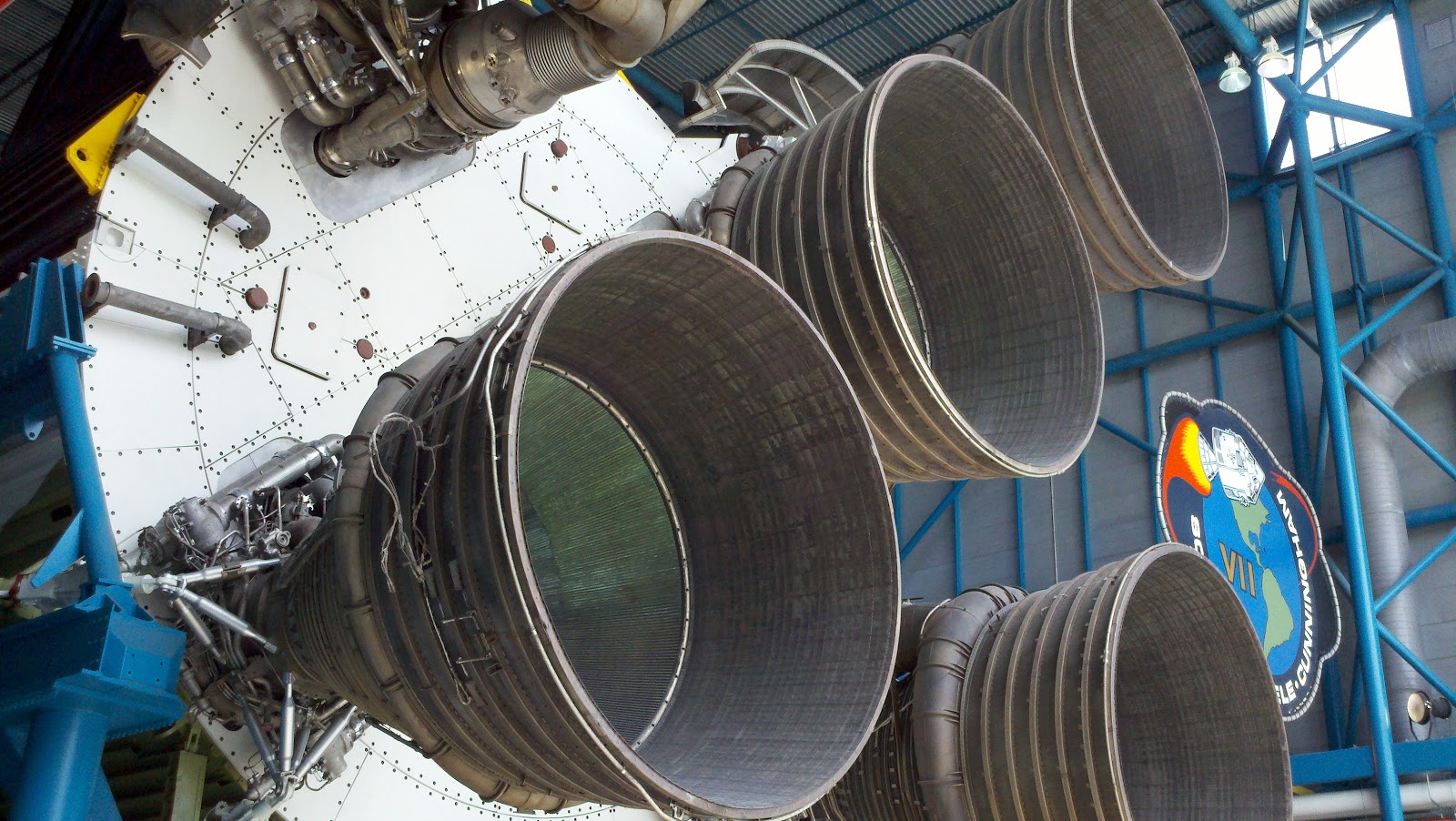
The highlight of the trip to KSC was the bus tour. Well, at least part of it. They take you to where they have a Saturn V rocket on display.
We saw one in Houston. This one was displayed with quite a bit more flash. There were more exhibits attached to it, including an opportunity to touch a moon rock. Well. You really cannot get used to seeing the Saturn V given that it is the largest rocket ever built and was the rocket they used to send many men to the moon. It has to be big because it has to be so powerful and carry an awful lot of fuel - enough to push the capsule past the earth's gravitational pull for quite a long way before it can escape earth's gravity and then engage the moon's gravity.
Let's just say that we have yet to manufacture a bullet that can move faster than the Saturn V. The manned Apollo missions were each launched aboard a Saturn V launch vehicle. The complete assembly including the Apollo spacecraft and the Saturn launch vehicle stood 363 feet tall and weighed over 6 million pounds. Ultimately, to get into lunar orbit, the multiple stage engines had to push to speeds in excess of 24,500 mph. That's definitely cookin' Baby!
![]() |
| Definitely the "business end" of a Saturn V |
![]() |
| It's so big, the photographs do not do it justice. It stands longer than a football field. |
However, for me, the piece de resistance, was the view of Launch Pad 39 where Endeavor was sitting ready to go (except for the fuel).
From where we were, on top of the obervation gantry, we could see that she was attached to the two solid rocket boosters, and the exernal fuel tank, resting quietly in her position on the launch pad. There are tall lightning rods around to hopefully fend off an electrical attack. She sits out there on the pad. Astronuats say that when they actually take their seats in the shuttle within an hour of the launch, and the external fuel tank is filled with its liquid hydrogen and liquid oxygen, she creeks and moans, pops and hisses, and has variably been described as a race horse in the shoot before the start of a race. She has a life and a feeling of just wanting to go like hell. Literally 31 seconds before launch, all control moves to the shuttle's various onboard systems. She comes truly alive.
There are millions of systems working simultaneously, and perfectly, all of which are absolutely necessary to get those millions of tons of hardware up into space. It may not be a terribly long trip, but it is furious. Once the solid rocket boosters are lit, they cannot be extinguished. Crazy! They powere the shuttle so fast that at a certain point in the launch, they have to trim and apply thrust from the main shuttle engines to slow down less the wings fall off and the shuttle colapse like a beer can under the enormous pressures involved. But there she was. You go Endeavor. We will look for your trail into space on April 29 from somewhere on the St. John River.
![]() |
| Brenda touching a piece of moon rock. |
Ultimately, we had a terrific time in Titusville. I wonder what will happen to the community when the shuttle program concludes? I understand our president, in his inimitable wisdom, is looking to turn space exploration and travel over to the private sector. NASA will essentially become a consulting firm and private companies will rent space on the launch pads. What NASA has done for American spirit and knowhow cannot be replaced by private sector management. Space exploration for the sake of itself will be replaced by space profit making and the cutting of corners. I'm not saying that it will ever be safe. But it would be a lot safer if dollars did not figure into the equation the way they do when private companies do business. For that matter, who will insure it? Oh well. Write to your representatives and let them know what a huge mistake it is to cancel the shuttle program. I know I will.
![]() |
| This guy showed up when we were washing down the boat for a sip of fresh water. |

We left Titusville this morning and rolled up the line to a place most of us have heard of, Daytona Beach. We got here late so we have not gone into town to do any exploring. I am not sure if we will, or if we will keep going on up to St. Augustine. We'll figure that out in the morning. In the mean time, be well.
Bye
Saturday, April 9, 2011
VERO BEACH - NOT AT ALL WHAT WE ANTICIPATED
Vero Beach was not at all what we anticipated. After having visited much of the Florida coast, I, speaking for both Brenda and myself, expected Vero Beach to be lined with high rise condos and expensive shopping, perhaps much like Fort Lauderdale. We were completely wrong. Vero Beach is, in large part, very similar to many mid-sized communities on the west coast. It is not rural, but it is not metropolitan. It has the feel of a suburb, but of what I cannot tell. Our friends Barry and Jodie had a truck, so we got to see a lot more of Vero than we would have otherwise had the opportunity to see. There is a part of Vero Beach that is on an island boardered on one side by the Atlantic Ocean, and on one side by the Indian River, and separated from the "mainland" by a large bridge. This part is called Orchid Island and is very beautiful. There are expansive parks, higher end restaurants, museums, and various other affluent treats. The other part of Vero, on the other side of the bridge, is also very nice, but in a more suburban sort of way. The "regular" folks live over there. This is also where you can find anything from Lowes to Subway, all the big box stores and long chain restaurants are there. Although we didn't avail ourselves of it thanks to Barry and Jodie, there is a bus system that is completely free to use and will take you to just about any place you want to go. Most lines lead to a central transit hub and then you hop on a different line, each of which is distinguished by color - the orange line, the green line, the blue line, etc.
We didn't really do much in the way of site seeing in Vero Beach, other than what went along with rides to the grocery store, the mall, etc. However, we did get the impression that this is a very cool place to live.
We went to a jazz concert at the museum with packed picnic baskets, blankets, and friends. Quite a few folks attended.
Other than that, we did not do too much. We got a few projects taken care of on the boat, and got together with friends for cocktails, card games, and treats on several occasions. It was a nice couple days.
We left Vero Beach on Friday and continued our trek north. After a long day, we stopped at a place called Green Dragon Point. It's only a couple miles north of Melbourne, and is situated at the confluence of the Indian and Banana Rivers. We are anchored in the community of Indiatlantic. There is nothing here of interest to us. It is very nice. We can see many very beautiful homes and a rather exclusive yacht club. We'll probably stay here over the weekend and then get moving again on Monday. Our plan is to get up to Titusville and go visit the Kennedy Space Center. Unfortunately, KSC is situated many, many miles from just about anything; way too far to ride our bikes to. So, we will have to consider all possible modes of alternate transportation. I have my research work cut out for me.
We didn't really do much in the way of site seeing in Vero Beach, other than what went along with rides to the grocery store, the mall, etc. However, we did get the impression that this is a very cool place to live.
We went to a jazz concert at the museum with packed picnic baskets, blankets, and friends. Quite a few folks attended.
Other than that, we did not do too much. We got a few projects taken care of on the boat, and got together with friends for cocktails, card games, and treats on several occasions. It was a nice couple days.
Subscribe to:
Posts (Atom)