Friday, July 8, 2011

ANNAPOLIS, FAIRLEE CREEK, AND CHESAPEAKE CITY, MARYLAND

Annapolis is a very nice town.  We came here after an extended visit to places on the Potomac River and found it refreshingly modern and beautiful.  We anchored in the Naval Anchorage right in front of the Naval Academy.  It was a little bumpy due to the south wind and due to the hundreds of boats moving about.  As the fourth of July holiday weekend was in full swing, this was a very boat-busy weekend, and hundreds, if not thousands of boats were out and about.  The anchorage was also quite noisy.  Every morning at 0600, over a thousand incoming Naval Adademy students performed morning exercises noisily on the grass in front of the anchorage.


Annapolis is the capital of Maryland.  It was originally called "Providence" when settled by the Puritans, and was later called "Anne Arundel's Towne" after the wife of Lord Baltimore.  In 1708, however, Royal Governor, Sir Francis Nicholson, moved the capital here from St. Mary's City, and chose to honor Princess Anne, heir to the throne of England.  She then chartered her colonial namesake as a city.  In fact, her royal badge, with a crown over the entwined thistle of Scotland and Tudor rose of England, is depicted on the Annapolis flag.


Nicholson certainly designed a beautiful city. Instead of using a customary grid, he constructed a baroque plan similar to many capitals in Europe using circles with radiating streets to create focal points, and to give importance to certain structures such as St Anne's, the Episcopal Church and the government buildings.  The Maryland State House, in one of these circles, is the oldest such capital building in continuous use in the United States.


In the other circle, rising over the harbor, is the State House, the seat of government. This urban design was admired by frequent visitor George Washington, who later had Pierre L'Enfant incorporate it into the nation's capital.


Shipping created great wealth in Annapolis.  Prosperous merchants and "planters" sought to duplicate the amenities of their homeland, and built enormous mansions. These homes entertained many of our founding fathers and have ballrooms and formal gardens.


Government has always played a major part in Annapolis. The same State House where George Washington tendered his resignation as General of the Continental Army following the Revolutionary War is still where the Maryland General Assembly meets in its chambers. The Governor and Lieutenant Governor have their offices there, and it is used for a number of state functions throughout the year.
The capital of Maryland was the country's capital when the Treaty of Paris, ending the Revolutionary War, was signed here. All four Maryland signers of the Declaration of Independence had homes in Annapolis, which still stand today.


For many, Annapolis is synonymous with the United States Naval Academy. However, this world famous institution isn't even the oldest college in town. That distinction belongs to St. John's College, founded in 1696 as King William's School. It is the third oldest college in the United States (after Harvard and William and Mary). Its liberal arts curriculum is based upon study of the Great Books.


The Chesapeake still plays a major role in commerce, even though Annapolis eventually lost out on the shipping trade to a much deeper harbor in Baltimore. Recreational boating, fishing, sailing and racing are activities that take place year round in Annapolis and are responsible for a vigorous maritime industry. Supply and service establishments dot the shoreline and comprise a major part of the local economy.

Annapolis is a very popular port of call for international sailors and in its anchorage one sees transoms from all over the world. Four years ago, the Whitbread competitors stopped here, and this spring the Volvo fleet returned.  In the fall, the largest in the water boat shows in the world are held on successive weekends for sail and power enthusiasts respectively.

Annapolis - the Naval Academy

The Naval Academy was founded in 1845. It is said here that, every day, as the undergraduate college of the naval service, the United States Naval Academy strives to accomplish its mission to develop midshipmen “morally, mentally, and physically.”  As future officers in the Navy or Marine Corps, midshipmen will someday be responsible for the lives of many and very expensive and complex equipment. From Plebe Summer through graduation, four years later, there is an extensive focus on integrity, honor, and mutual respect.


Just as the Naval Academy promotes the moral and mental development of midshipmen, there is a huge emphasis on physical development.  Athletic teams are an integral part of the overall education since they provide leadership opportunities and the experiences of team play, cooperative effort, commitment and individual sacrifice. In the academy's program everyone has a wide variety of athletic choices, as well as the required physical education curriculum.
The Navy pays for the tuition, room and board, and medical and dental care of Naval Academy midshipmen. Midshipmen also enjoy regular active-duty benefits including access to military commissaries and exchanges, commercial transportation and lodging discounts and the ability to fly space-available in military aircraft around the world. Midshipmen pay is $764 monthly, from which laundry, barber, cobbler, activities fees, yearbook and other service charges are deducted. Actual cash pay is $75 to $100 per month during the first year, increasing each year to $400 per month in the fourth year.


Every midshipman's academic program begins with a core curriculum that includes courses in engineering, science, mathematics, humanities and social science designed to provide a broad-based education that will qualify the midshipmen for practically any career field in the Navy or Marine Corps.

We visited the USNA at the very beginning of Plebe Summer.  All midshipmen begin the four-year program with Plebe Summer, a period designed to turn civilians into midshipmen. According to the Academy, Plebe Summer is no gentle easing into the military routine. Soon after entering the gate on Induction Day, new students are put into uniform and taught how to salute by the first class midshipmen and officers who lead the plebe indoctrination program. For the next seven weeks, they start their days at dawn with an hour of rigorous exercise and end them long after sunset. Forget television, leisure time or movies.  Plebes will have barely enough hours in the day to finish their assigned plebe tasks.


Naval Academy Chapel is a focal point of the Academy and the city of Annapolis as the dome can be seen from miles away.
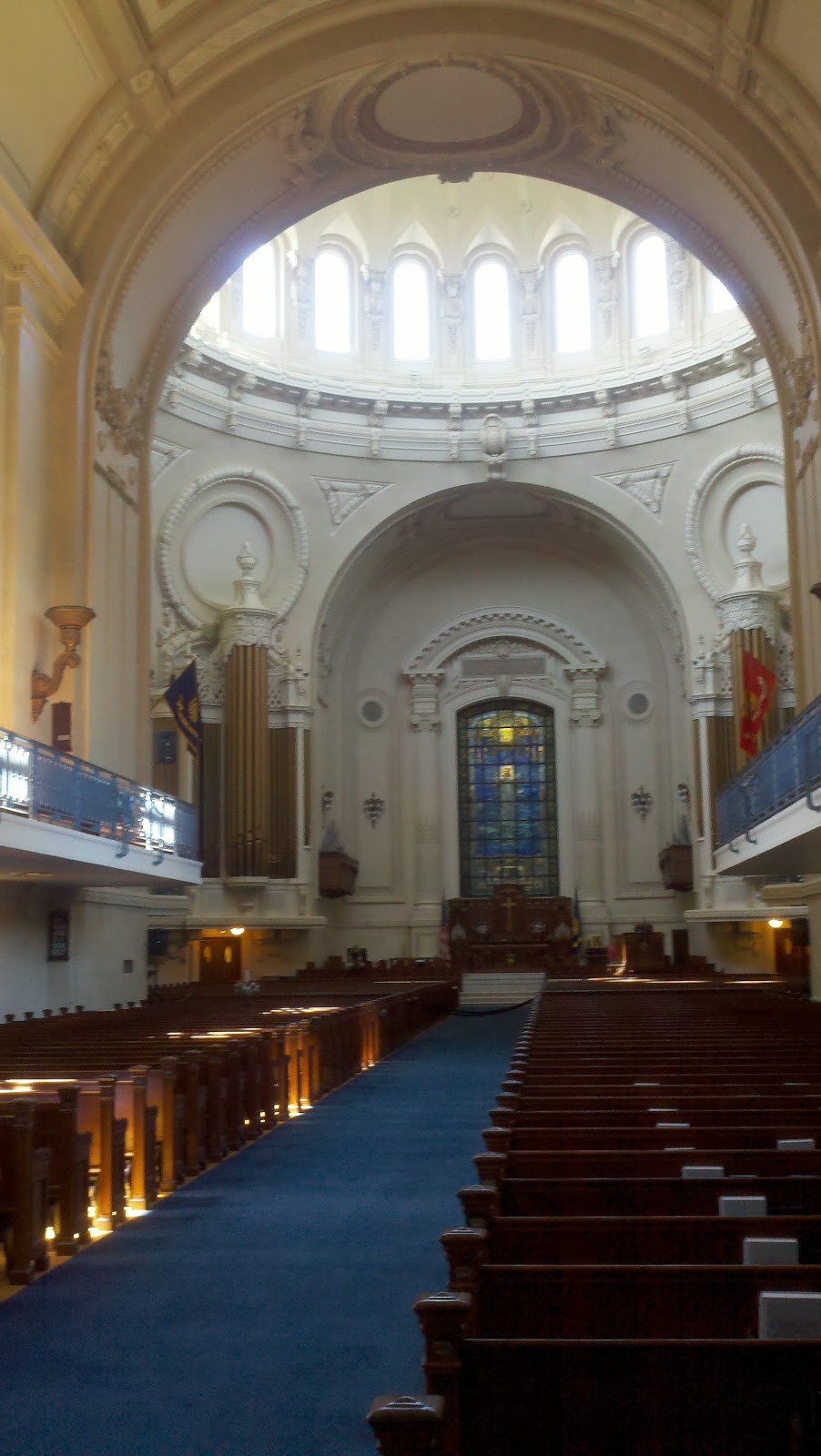
While the chapel is quite beautiful, it is also the place to visit the crypt of legenday American sailor, John Paul Jones.


John Paul was born in Kirkbean, Kirkcudbrightshire, Scotland, and went to sea as a youth  He was a merchant shipmaster by the age of twenty-one. Having taken up residence in Virginia, he volunteered early in the War of Independence to serve in his adopted country's infant navy.  His claim to fame is that he took the war to the enemy's homeland with daring raids along the British coast and the famous victory of the Bonhomme Richard over HMS Serapis. After the Bonhomme Richard began taking on water and fires broke out on board, the British commander asked Jones if he had struck his flag. Jones replied, "I have not yet begun to fight!" In the end, it was the British commander who surrendered.

FAIRLEE CREEK -

We surrendered to the rolly Annapolis anchorage after two nights and moved on to a place called Fairlee Creek, Maryland, where we enjoyed the 4th of July holiday.


Fairlee Creek is a small, but extremely well-protected and beautiful piece of water located on Maryland’s upper Eastern Shore. Fairlee Creek is 15 miles northwest of the mouth of the Patapsco River and 21 miles south-southeast of the C&D Canal’s western entrance near Chesapeake City.  The charts showed the water depths to be rather shallow, but the cruising guides said something different, and up to date blogs of recent passers-by said something else.  So, if you averaged out all the information, then we had enough water to get in and anchor.  In actuality, the mouth of the bay was the only hairy part with a tough current moving across the mouth striving to put you on the beach.  We made it in and out without any problem.  While we were there, we had a nice time.


No 4th of July would be complete without cocktails by the pool.  Barry and Jodie got Brenda a pool for her birthday and we just had to try it out.  Rum drink anyone?  The finger you see in the foreground is Barry playing in the fountain.....silly kid.

So, after a couple days in Fairlee Creek, it was on to Chesapeake City just a couple miles up the C&D Canal.

CHESAPEAKE CITY

The mouth of the C&D Canal
As early as the 17th century, local settlers recognized the possibility of connecting the Chesapeake Bay with the Delaware River.  In the mid 1760s, possible canal routes were surveyed, but in 1824, construction began at the Chesapeake City location.  The canal was completed in October of 1829.  At that time, there were reported to have been two structures standing in what was then known as Bohemia Village: a pre-revolutionary building known as Chick's Tavern House and a lock house for collecting tolls. The town subsequently grew in response to the needs of the canal operations and commerce. In 1839, the town changed it's name to Chesapeake City and the population reached 400.


Today, Chesapeake City's historic area is on the National Historic Registry, as well as Maryland's Historic Registry. The town has many restored historic homes, shops and galleries. Additional sights include the Canal Museum, art galleries, summer concerts, boat tours, and tours of the nearby horse country. There are also many fine restaurants and bed and breakfasts. Chesapeake City has a lot of  Victorian charm and has actually been featured in several national magazines. 


And, you're not going to believe this, but we found yet another.........


Wait for it...................


Yes.................

ANOTHER TIKI BAR!!!!


We stayed one night in Chesapeake City as it was a logical stopping point on our trek to Philadelphia where we are now.  More later from Philadelphia.

Bye now.

Saturday, July 2, 2011

D.C. TO ANNAPOLIS

When we left Washington D.C., we again had to travel a little more than 100 miles on the Potomac River, only this time we did it in reverse.  Our goal was to stay on the Maryland side of the river if and when we made stops.  As it turns out, before leaving this great river, we made 2 stops and had some very nice times.

Parts of the Potomac River were like a mirror.
Our first stop on our trek back down the Potomac was at a place called Cobb Island.  Never heard of it?  Neither had we.  I was perusing the charts when I saw this place that looked like it would provide good protection for the night in just about any conditions.  Then I looked it up in the cruising guides.  Also, since we have had good internet connectivity all the way down the river, I was able to check the place on Activecaptain.com.  It sure looked good.  More importantly, however, it looked like an opportunity to have a local culinary experience.  One of the cruising guides mentioned this place where you can eat really fresh Maryland Blue Crabs.  Had to do it!  So we pulled into this anchorage and dropped the hook. 

This was a beautiful anchorage.  It was like being in the middle of a pool surrounded by beautiful Chesapeake Bay homes.  What's more, we were, for the first time, anchored in yet another state; the beautiful state of Maryland.

There we are anchored in the bay at Cobb Island.
So there we were, anchored at Cobb Island, and we hopped into the dinghy and motored over to Shymansky's Marina, Bait Shop, Fuel Dock, Tool Shed, Restaurant, Bar, Ships Store, Marine Supply, Convenience Store, Etc., (small town.....you get the idea), and asked permission to tie up for a little while so we could explore the town.  He pretty much said we had already seen it and hoped we hadn't blinked, but if we wanted to........sure.  He asked us where we were from.  Somehow, he knew pretty much right off the bat we were not locals, so we told him, Santa Barbara, California.  He and two other guys sitting at the counter railed off a flurry of expletives and then said, "Really?"  We said, "Really."  They were all friendly folks.  So, off we went in search of Maryland Blues.

Since Shymansky's Crab House was closed Mondays, we headed across the street to another Crab House and found what we were looking for - a menu that had lots of crab stuff, and a steak for Brenda.  Now, I don't know about you, but I had never eaten a Maryland Blue Crab before.  Well, on the way down the river, I pondered just such an eventuality, and did a quick search on the droid and actually found three U-Tube videos that explained how to eat a Maryland Blue Crab.  So, I was all set.  Nevertheless, when the waitress came to the table, I did not hesitate to let her know I was interested in eating some and had never actually had any experience with them beyond a U-Tube video.  She was very nice.
First, she came back with beer and wine and a cover for the table a welder could have used in a metal shop, along with a wodden hammer and a knife.  Brenda's reaction was to ask if she was going to get a shield of some sort to protect her from the effect of hammer usage on crab on the covered table.  Well, the waitress just sort of looked at her and said nothing.  Then we discussed the menu.  I saw a guy with a red plastic tray stacked high with crabs and asked about it.  She said that guy was eating the crab extravaganza - sort of an all you could eat affair.  She directed me away from that, however, citing my inexperience, and suggested I try a simple half dozen steamed.  So, I said, "Sure, what the hell?" and ordered that.


Soon thereafter, arrived an orange plastic tray stacked with 6 of the most delectable, steaming hot Maryland Blue Crabs I have ever seen.  (Well, let's not forget that, this was the only orange plastic tray stacked with 6 of the most delectable, steaming hot Maryland Blue Crabs I have ever seen.)


So off we went.  I dug into the crabs like I had seen on the videos and it actually worked.  They were really good.  I highly recommend them.  Messy, but delicious.  We had a fun time there.  Then it was back to the boat.

Since we had seen the town, and eaten at one of the two crab houses, we decided we need not stay another day, and decided to make tracks in the morning for the bottom of the Potomac River, to an anchorage as close to the mouth as possible so we could wait out some weather before reaching the Chesapeake Bay and turning left.  So, we stopped for the night in a place called Smith's Creek.


Smith's Creek is a place you go to relax as there is absolutely nothing there, but trees and good water.  Again, once you wind your way in through the marks, you are surrounded by greenery.  It was quite beautiful and made an excellent refuge from the storm that pounded the crap out of us that night.  Interestingly, we saw it coming on the radar as we were heading down from Cobb Island.  For a while there, I was really wishing I could squeeze a few more knots out of the old girl, but the storm kept sweeping around us and not over us.  So, we got in without incident.  We did get it right in the teeth that night, though.


This was one hell of a storm.  It came from off the land, so it was not packed with that much moisture.  What it involved was a cold front coming from the north and meeting the warmer Atlantic airmasses over the lower Potomac tidal basin.  The storm was, however, full of lightning fury.  It was quite the electrical show.  Needless to say, as you can probably tell by now, we made it through just fine.  We have become accustomed to storms and know what to do.


The next day was not the day to be on the Chesapeake, so we just held tight where we were and had a relaxing day doing pretty much nothing in beautiful surroundings.  We did enjoy taco night over on Love Shack, however, and talked with Barry and Jodie about where were going next.  We both had already decided we were going to Solomon Island, so that was not tough.


I'm not sure really why folks crowd Solomon Island.  There is plenty of stuff for the cruiser there, but not a whole lot more than that.  It is a nice place with nice marinas, and some anchorage room in the harbor.  We anchored, per usual, and had a nice evening.  We dinghied over to a place called the Captain's Table and met Barry and Jodie for dinner.

As you will read below, it was kind of a rough day on the water so I was glad the Captain's Table had Captain Morgan.  The other thing they had was the opportunity for another local culinary experience - the deep fried soft shell crab.  Never had one of these before.  Hell, never even seen one.  Fortnuately, Barry had, and he explained that they are usually served between two slices of white bread.  Well, I decided to have the platter which included two and some sides.  The two crab arrived nicely deep fried.  Now, you have to understand that these are served intact with all parts attached and deep fried.  The object I guess is to catch them when they are nearing a molt so their shells are very soft and chewable.  Then, roll them in flower and deep fry.  They were delicious.  I could actually cut them with a fork.  Another food feat accomplished.  Highly recommended.


This day, on the way to Solomons, the trip was not boring as usual - which, by the way, I like.  No.  At first, I noticed that the voltage meter was giving me some strange readings.  I noticed that it had dropped from 12.7 (on the upward charging swing) to 11.5.  I'm thinking to myself this is not right.  So, I thought something electrical was happening and I went looking for the heavy draw.  I found nothing.  Then, I noticed the tachometer was completely going haywire, and concluded my alternator was suffering.  So, I carry a spare, and would simply change it out when we got there.  The engine sounded fine and I saw no abnormalities in temperature or oil pressure; no smoke or anything else that would have clued me in to an engine problem. 


Passing Point No Point.  What's the point?  I love the Chesapeake.
So, having concluded that the alternator was freaking out, I decided to just check to make sure it was still there and that the belt was on it.  If the belt comes off, we risk overheating because the same belt is on both the alternator and the water pump.  When I opened the hatch, however, the engine room was wet and there was a bunch of water under the engine.  Ok, stop the engine and shut down.  When I opened the other side of the engine hatches, I saw water pumping out from under the space where the water heater is. 

So, when you appear to have water where it is not supposed to be, the first thing you have to do is determine the source.  Now, for those nonboaters out there reading this dribble, two things are important when you are looking for the source of a leak:  1.  is the water fresh or salt?  2. is the water hot or cold?  Well, if you got hung up on the first question, good for you because there ain't no salt water this far up the Chesapeake Bay.  Thus, the issue could have become more complex, but even the fresh water of the bay has a smell to it.  So, we determined it was definitely not salt water.  Next, was it hot or cold?  On first glance, there was a lot of steam so I feared that it was hot.  I thought I had blown a hose that connects the engine's heat exchanger to the water heater.  Then it occurred to me that, had that been the case, I would have been sensing hot coolant spraying all over the engine room......and it was not coolant.  Ok.  Time to regroup. 


This time, I strapped on a head light and went into the engine room through the generator hatch and discovered the source of the leak.  I always hesitate to do this with a hot engine since it is a very dangerous proposition.  Not only is it very hot down there, but if there really were something wrong with the engine's cooling system, then there was the risk of a hose blowing or the cap on the heat exchanger letting loose and I could be sprayed with very hot liquid and possibly burned badly, so we always approach these things with extreme caution.  This, and the boat was not at a dock.  Of course, we were drifting and rolling slightly.  Well, within a minute I found the source of the leak. 


There is metal T fitting on the bottom of the accumulator tank for the fresh water system.  In one side of the T was a plastic fitting with a hose barb on it.  The barb broke.  As such, pressurized fresh cold water was gushing out of the bottom of the accumulator tank and spraying on the engine which, of course, included the alternator.  So, this was why we were getting such strange electrical readings.  Solution?  Turn off the water pump and allow the accumulator tank to drain.  No more water leak.  I suspect we lost 30-40 gallons of fresh water, but oh well.  If we run out, we can always get more.  Hey, this is America, right?


So, we cancelled the tow boat, and made our way to Solomons.  Within an hour, I had the problem repaired as I just so happened to have a fitting to replace the broken one with.  However, it too is plastic.  It will do for now, but when I get to a place with a real hardware store, I think I will replace it with metal.


So, we had a nice evening in Solomon Island and left the next morning for Annapolis, where we are now.  It was a bumpy ride for the first several hours, but it calmed down and we got settled into our anchorage spot right in front of the Naval Academy.  More on Annapolis later.


By for now.